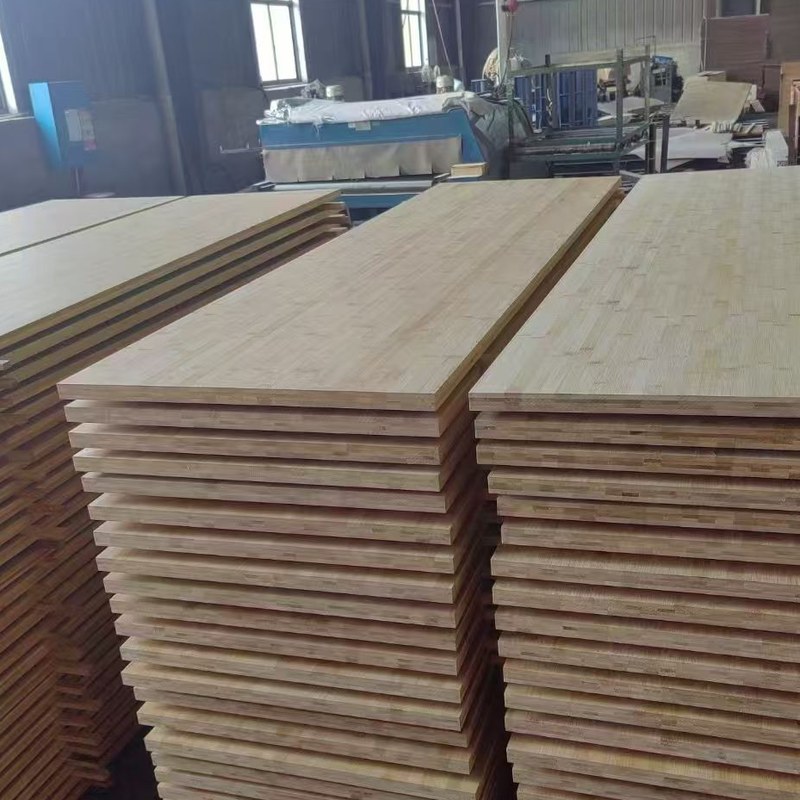
Bamboo board for industrial pallets is a dense, pressed panel that behaves like a heavy hardwood board: it holds deck boards and blocks firmly, resists moisture in transit, and can be cut and nailed with standard pallet tooling.
Why consider bamboo instead of hardwood
- Consistent density — no knots, no sap pockets, fewer failed fixings.
- Moisture resistance — thermally modified bamboo absorbs less water than many softwoods, so pallets deform less in humid containers.
- Stable supply — bamboo regenerates in years, not decades, so pricing is less volatile than tropical hardwood.
- Cleaning — a smooth, hard surface is easier to sweep and, if required, wash.
Load performance
| Requirement | Bamboo board answer |
|---|---|
| Static load | High compressive strength from 1100–1250 kg/m³ density |
| Impact | Tough, splinter-resistant surface |
| Repair | Deck boards can be replaced individually |
| Fixings | Standard nails, screws and staples; pre-drill near edges |
Export considerations
Engineered bamboo is a processed product rather than raw wood, which buyers often prefer when they are trying to avoid the cost and delay of solid-wood heat-treatment procedures. Confirm the exact import requirements of the destination country with your freight agent, and request material declarations from the supplier.
Cut-to-size service
Boards can be supplied in standard pallet thicknesses or cut to your deck layout, which reduces wastage and assembly time on the pallet line.
Browse engineered bamboo boards or request industrial board pricing.