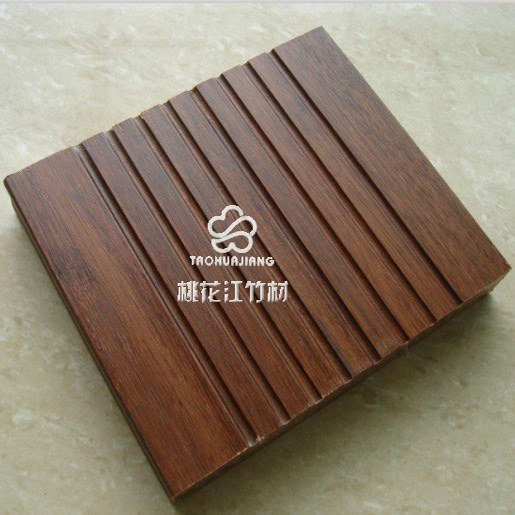
A bamboo equipment base plate is a high-density engineered bamboo slab used as a machine base, levelling pad, jig bed or work-holding surface. Because the material is pressed rather than sawn from a log, its density and thickness are predictable — which matters when a fixture must repeat within a tolerance thousands of times.
Why bamboo works as a base or jig material
- High compressive strength — 1100–1250 kg/m³ density carries heavy static loads without crushing.
- Dimensional stability — low moisture movement keeps a fixture bed flat in a workshop.
- Machinability — cuts, mills, drills and threads cleanly for locating pins and clamps.
- Vibration damping — a natural composite absorbs vibration better than a steel plate, reducing chatter on finishing operations.
- Wear resistance — hard surface resists abrasion from repeated loading.
Typical applications
- Machine and equipment base plates — footings and levelling pads under machinery.
- Automation jig beds — fixture plates and work-holding surfaces.
- Warehouse and logistics — shelving decks, loading ramp boards and floor protection.
- Workshop surfaces — assembly tables, cutting boards and sacrificial beds.
Specifying the plate
| Parameter | Notes |
|---|---|
| Thickness | 10–60 mm, laminated to thicker sections |
| Density | Specify per load case; higher density = higher strength, more weight |
| Surface | Sanded flat; antistatic and abrasion-resistant options available |
| Tolerance | Confirm flatness and thickness tolerance for the fixture design |
| Cutting | Cut-to-size with drilled and countersunk holes on request |
Working with bamboo plates
Seal edges and drilled holes to limit moisture uptake, keep the plate supported across its full area rather than on point loads, and replace sacrificial surfaces before wear reaches the structural thickness.
See the engineered bamboo range or send your plate drawing for a quotation.