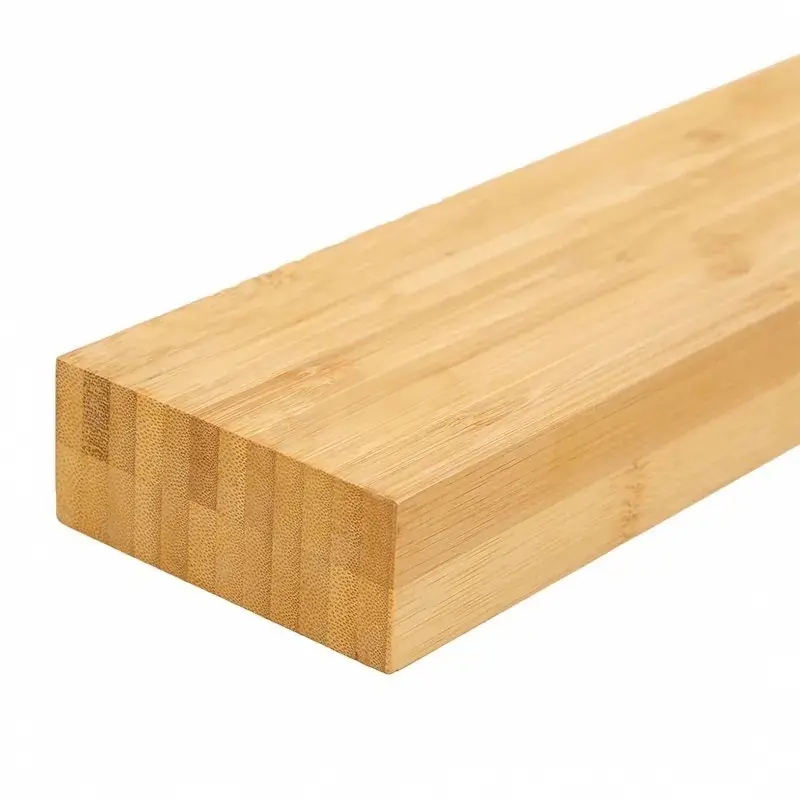
Bamboo laminated timber — often called bamboo glulam or bamboo LVL depending on how it is built up — is now a realistic alternative to softwood glulam for exposed structural work. It is stiffer and stronger per unit of weight, visually distinctive, and available in consistent long lengths. It is also a different material with different rules. Here is how the comparison actually plays out.
How the two materials are built
Glulam is made from softwood laminations glued face to face, with defects distributed through the section. It is a mature, well-coded product with published strength classes (GL24h, GL28h and so on) and standard connection design rules.
Bamboo laminated timber is built from bamboo strips or strands, glued and pressed into beams and columns. Density is higher (often above 900 kg/m³), which raises stiffness and makes the material harder and heavier in the hand. Because it is newer, published design values vary more between manufacturers.
Strength and stiffness
- Stiffness (E) — bamboo beams commonly specify values in the 9–13 GPa range depending on grade and orientation, comparable with mid-to-high glulam classes.
- Bending strength — engineering values in the 60–90 MPa range are quoted for structural bamboo grades, above typical softwood glulam.
- Density — roughly 700–950 kg/m³ for bamboo, against 450–500 kg/m³ for softwood glulam. That extra mass helps acoustics and vibration but adds dead load and handling effort.
Treat all of these as indicative until you have the manufacturer’s test data and, ideally, a third-party assessment. There is no single European strength class for bamboo yet, so the engineer has to work from the specific product’s declared values.
Span
Because stiffness is comparable but density is higher, bamboo beams usually span similarly to a mid-range glulam of the same depth, with slightly more self-weight to carry. As a first pass, a span-to-depth ratio of about 18–20 for simply supported floor beams and 20–24 for roof beams is a reasonable starting point — then let the engineer check deflection, which almost always governs.
Connections
- Density makes bamboo harder to drill and screw; pre-drilling is mandatory.
- Splitting risk near edges is real — respect minimum edge and end distances.
- Steel plates and concealed brackets work well; use stainless or appropriately protected steel outdoors.
- Design for moisture: bamboo moves less than softwood but is not immune.
Fire
Dense bamboo chars slowly and predictably, which is good for exposed structural use: the residual section after a fire can be calculated. As with glulam, the fire strategy should be based on a charring rate supported by test data, not on a generic timber figure.
Cost and availability
Glulam wins on availability, standardisation and price per cubic metre — it is produced locally in most markets and comes with familiar design codes. Bamboo laminated timber costs more per cubic metre and needs longer lead times, but it can be competitive where:
- the structure is exposed and the material is part of the design intent;
- long, straight, consistent sections matter;
- a biobased, fast-renewing material supports the project’s sustainability targets.
What to specify before tender
- Declared E, bending strength and density, with test reports.
- Adhesive type and emissions class, plus exterior-grade confirmation if relevant.
- Moisture content at delivery and allowable in service.
- Surface finish and UV protection for exposed work.
- Fire classification and charring rate data.
- Certification (FSC®) and EUDR documentation where required.
- Tolerance on straightness, twist and section size.
Frequently asked questions
Can bamboo replace glulam structurally?
For many beams and columns, yes — subject to the engineer designing to the product’s tested values rather than to a generic class.
Is bamboo laminated timber heavier?
Yes, noticeably. Plan lifting and temporary works accordingly.
Does it need a finish?
Indoors, a hard-wax oil is usual. Outdoors, a UV-stable coating system and a ventilated detail are essential.
Our bamboo architecture and components range includes laminated beams and columns with test data, and the laminated timber range covers panels and boards. Send your span, load and exposure and we will come back with sections and documentation — contact us.