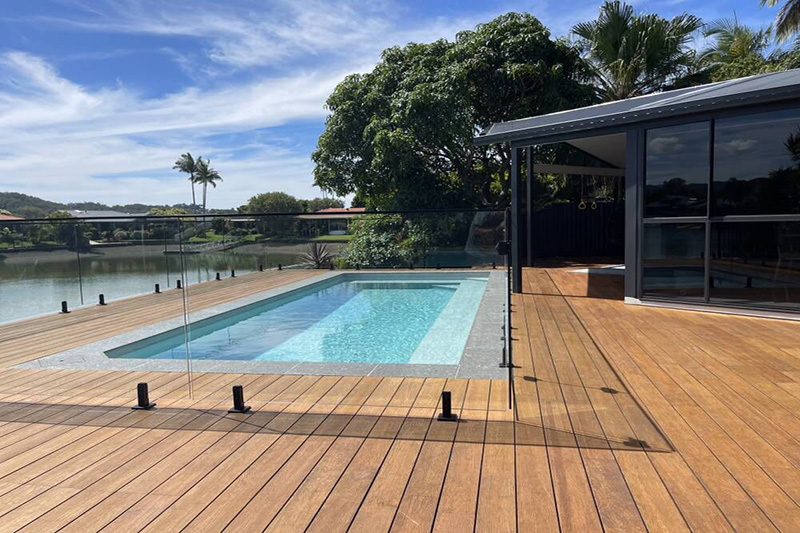
All three materials can make a good deck. They fail in different ways, need different maintenance and sit at different price points. The right choice depends on exposure, budget and how much upkeep the owner will actually do.
How each material behaves
Bamboo decking
Thermally modified, densified bamboo: hard, dimensionally stable and consistent in colour. It looks like a hardwood deck, feels warm underfoot and takes a penetrating oil finish. It is a natural fibre product, so it still needs periodic oiling and should not sit in standing water.
Teak
The benchmark for outdoor hardwood: naturally oily, extremely durable, superb underfoot and it weathers to a soft silver if left untreated. It is also the most expensive option by a wide margin, and supply is increasingly restricted by legality and certification requirements.
WPC (wood-plastic composite)
Plastic and wood flour extruded into boards. No oiling, no rot, uniform colour — and a plastic feel that some clients dislike. It expands and contracts with temperature, can fade, and quality varies enormously between manufacturers.
Durability and movement
- Rot and insects — WPC is immune; teak is naturally resistant; bamboo depends on the thermal treatment and coating, but good material performs well for a decade plus.
- Moisture movement — bamboo moves least of the three natural options because of its density; teak moves moderately; WPC moves thermally (length changes, not swelling).
- Surface wear — bamboo is the hardest underfoot; teak is close; WPC marks and scratches more visibly.
Maintenance reality
- Bamboo — clean regularly, re-oil every 12–24 months depending on exposure.
- Teak — clean and optionally oil; leaving it untreated is a legitimate choice and reduces work.
- WPC — wash with soap and water; no finish required, but stains can be stubborn and fading is not reversible.
Cost positioning
In indicative terms, delivered to a European or North American project: WPC sits at the low-to-middle of the range, bamboo in the middle, and teak at the top — often several times the cost of the other two. Freight, profile and coating move these positions more than most buyers expect, so compare quoted landed cost, not FOB price.
Which should you specify?
- Premium natural look with a realistic budget — bamboo decking.
- Zero-maintenance commercial walkway — good-quality WPC.
- Marine, heritage or prestige residential — teak, if the budget and certification allow.
- Hot climates with intense UV — compare light-coloured bamboo and light WPC; dark surfaces get uncomfortably hot.
Frequently asked questions
Does bamboo decking get hot in the sun?
Dark colours absorb more heat. A light carbonized tone stays noticeably cooler underfoot than a dark WPC board.
Can bamboo decking be refinished?
Yes. Lightly sand and re-oil — the colour goes through the board, so sanding does not expose a different tone.
Is WPC more sustainable than bamboo?
WPC often contains recycled plastic, but it is not biodegradable. Bamboo is a fast-renewing grass and, with FSC® certification, has a strong sustainability story. Judge by the specific product’s documentation.
Our light-carbon outdoor range is the usual choice for hot climates, and the high-carbon range for cooler, wetter exposures. Send us the project location and we will recommend a tone and coating — contact us.