Fire is the question that stops more bamboo specifications than any other. The good news is that engineered bamboo can meet demanding requirements — but only when the product, the treatment and the test report all line up. A catalogue claim is not a compliance document.
Reaction to fire vs fire resistance
These are different tests and are often confused in sales literature.
- Reaction to fire — how the material itself contributes to a fire: ignition, spread, heat release, smoke. Classified in Europe under EN 13501-1 (A1 to F, with s1–s3 smoke and d0–d2 droplet suffixes).
- Fire resistance — how long an assembly (wall, floor, beam) holds back fire: integrity, insulation and load-bearing capacity, expressed in minutes (R/E/I).
A board with a good reaction class does not automatically give a fire-resistant assembly. The assembly needs its own test or assessment.
What ratings are realistic?
Untreated bamboo behaves like a hardwood: it burns, with a predictable charring rate. With proprietary fire-retardant treatment, engineered bamboo products can reach Euroclass B-s1,d0 for wall and ceiling surfaces, which satisfies most interior specification requirements. Exterior cladding often targets B or C depending on the cavity and the building height rules in the local code.
Always read the classification report for the exact product, thickness and fixing method. A classification for a 15 mm board does not transfer to a 25 mm board, and a report for an interior panel does not transfer to a ventilated facade.
Charring and structural use
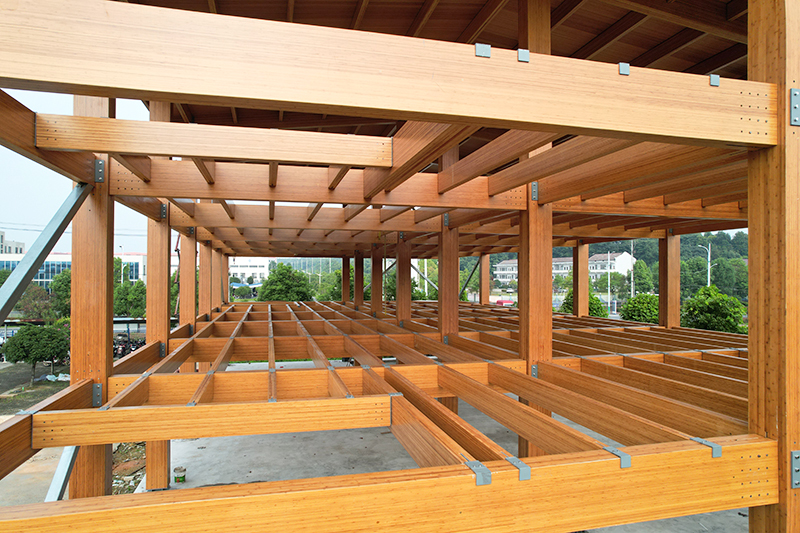
For exposed structural bamboo, designers use a charring rate to calculate the residual section after a fire. Rates vary by density, adhesive and treatment; typical engineered bamboo values are in the same order as dense hardwoods. Ask the supplier for a charring rate supported by test data, and design to your local structural code — do not extrapolate from timber tables without justification.
The checklist to send a supplier
- Which EN 13501-1 class applies to this exact product and thickness?
- Can you send the full classification report, not the summary page?
- Does the class still apply after the specified coating or oil is applied?
- What is the tested charring rate, and under which standard?
- Does the treatment affect colour, strength or moisture movement?
- Is the fire treatment compatible with exterior exposure and with the finish warranty?
Design moves that help
- Keep large bamboo surfaces out of concealed, poorly ventilated voids.
- Detail facade cavities with fire stops at floor lines where the code requires them.
- Use bamboo as a lining over a rated substrate when the assembly, not the board, must be rated.
- Confirm sprinkler and egress assumptions with the fire engineer early — retrofitting is expensive.
Frequently asked questions
Is bamboo worse than timber in a fire?
Not inherently. Dense engineered bamboo behaves broadly like dense hardwood. Performance is driven by treatment, section size and the assembly.
Does fire-retardant treatment reduce durability?
It can affect colour and, in some systems, moisture behaviour. Test compatibility with the exterior coating before committing to a large order.
Can I use bamboo on an escape route?
Only if the surface class and the assembly meet the requirements for that route in your jurisdiction. Check with the local authority before specifying.
Our bamboo architecture and components range can be supplied with project-specific fire documentation. Tell us the required class and the assembly, and we will confirm what is testable — contact us.