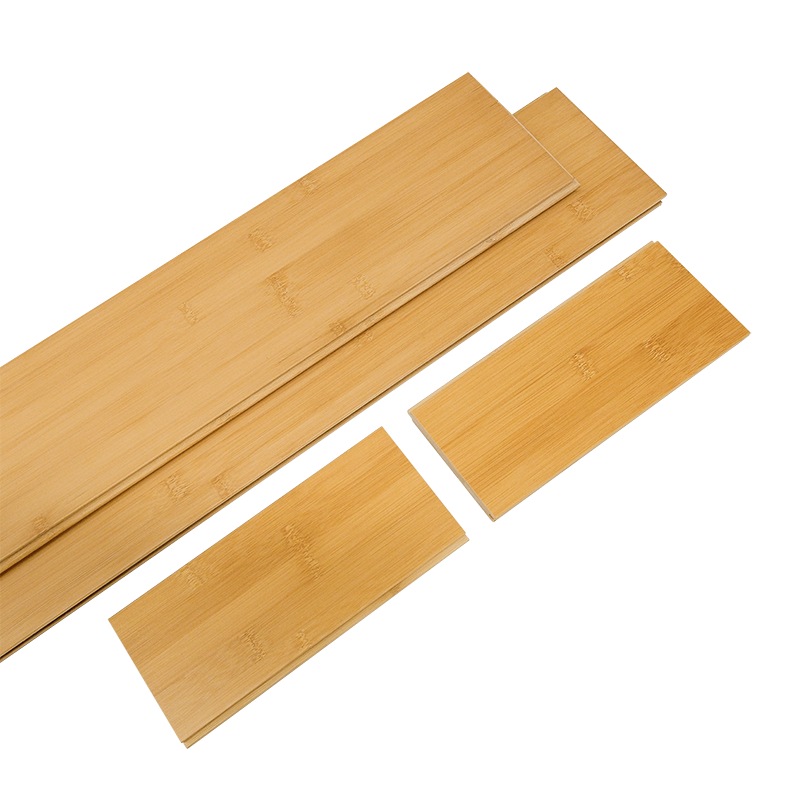
Strand woven bamboo is the densest form of engineered bamboo. Instead of gluing whole bamboo strips together, the raw poles are crushed into long fibre strands, coated with adhesive and pressed under high heat and pressure into a solid block. The result looks like a hardwood board, but behaves differently — and for demanding floors, tooling and industrial surfaces, that difference is the whole point.
How strand woven bamboo is made
- Harvest and split — 4–6 year old moso bamboo poles are split into strips, then crushed into loose fibre strands.
- Carbonise or bleach — steam treatment sets the colour (caramel for carbonised, pale for natural) and reduces starch.
- Dry and glue — strands are dried to a controlled moisture content and coated with resin.
- Press — high-pressure pressing fuses the strands into a block with almost no voids.
- Machine — the block is planed, profiled and finished into flooring, boards or blanks.
Why density is the number that matters
Strand woven bamboo typically reaches 1,100–1,250 kg/m³. Standard solid bamboo strips usually sit around 700–900 kg/m³, and oak is roughly 700 kg/m³ at 12% moisture content. Higher density means better resistance to indentation, less movement under load and a quieter surface underfoot.
Suppliers commonly quote Janka hardness in the 3,000 lbf range for strand woven bamboo, against roughly 1,300–1,400 lbf for European oak. Treat published hardness figures as indicative: pressing pressure, resin content and strand quality vary, so always ask for a test report from the actual production line rather than a catalogue sheet.
Where strand woven bamboo wins
- High-traffic flooring — retail, hospitality and apartments where dents show quickly on softer surfaces.
- Industrial tooling bases — a stable, non-metallic base plate that replaces hardwood in jigs and fixtures.
- Worktops and countertops — dense enough to take an oil finish and resist knife marking better than strip bamboo.
- Transport and trailer decking — where weight and wear resistance both matter.
What to check before you buy
- Density statement — ask for the tested value, not just “high density”.
- Adhesive and emissions — E0 or E1 class formaldehyde, or a documented no-added-formaldehyde system.
- Moisture content — 8–12% for indoor use; specify the target for your climate.
- Certification — FSC® chain of custody if the project requires certified material.
- Sample first — colour varies between batches, especially on carbonised material.
Strand woven vs solid bamboo in one paragraph
Choose strand woven when hardness, dimensional stability and wear life decide the specification. Choose solid strip bamboo when you want a visible, furniture-like grain and a lighter board. For exterior decking and cladding, the decision is different again — those products rely on thermal modification and density rather than strand orientation.
Frequently asked questions
Is strand woven bamboo waterproof?
No engineered bamboo is fully waterproof. Strand woven boards resist moisture well because of their density and closed structure, but standing water will still damage them. Use them indoors, or outdoors only in products specifically built and finished for exterior exposure.
Does strand woven bamboo scratch easily?
It is markedly more scratch resistant than strip bamboo or oak, but a sharp point or grit under furniture will still mark the finish. Felt pads and a doormat solve most complaints.
How long does it last?
In residential use, 15–25 years is realistic for a quality board with a maintained finish. In commercial use, expect the finish to need renewal before the board itself fails.
Our strand woven and solid bamboo flooring options sit inside the bamboo laminated timber range. If you are comparing grades for a project, send us the duty, span and finish you need and we will match a board to it — start from the contact page.