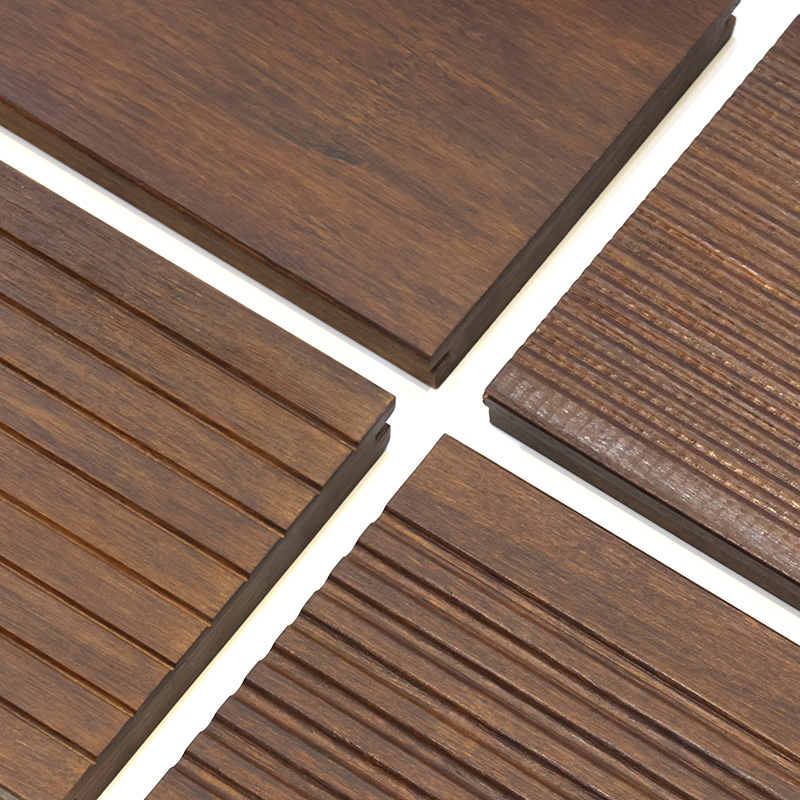
Buyers compare bamboo decking by price, colour and hardness data – and usually skip the question that decides all three: where did the bamboo actually grow? Species gets the attention; origin sets the ceiling on what any factory can build with it.
What season extremes do to a bamboo culm
A bamboo culm is a natural composite: cellulose fibre bundles in a starch-and-sugar matrix. In regions with mild, even climates, moso bamboo grows quickly and the fibre structure stays comparatively loose. In our sourcing regions of northern China, culms live through hot summers and winters that freeze hard. Growth slows in the cold months, fibre bundles pack more tightly, and the culm wall ends up denser for the same age.
The same cycle lowers the starch and sugar load inside the culm. Cold seasons interrupt the sugar transport that attracts borers and mould after harvesting – which is why winter-harvested, northern-grown bamboo starts cleaner before any treatment even begins.
Tighter thermal tension, tighter grain
Years of swelling in humid summers and shrinking in freezing winters leave the fibre structure conditioned under repeated thermal tension. When those strands are crushed, dried and re-pressed into heavy bamboo boards, the tighter starting grain locks into a denser, more dimensionally stable block. In practical terms for outdoor bamboo decking: less movement between wet and dry seasons, edges that stay crisp, and surfaces that keep their texture instead of fuzzing or splintering.
Why we source from northern bamboo farms
- 4-6 year culms only – young bamboo is weak; over-mature bamboo is brittle. Age selection happens at the farm, not the factory.
- Winter harvest windows – the lowest starch content of the year, and the cleanest raw material.
- Farm-level traceability – we know which region and season every batch comes from, and can hold that consistency across repeat orders.
Sourcing is also the quiet half of certification. FSC chain-of-custody and EUDR due-diligence both start with knowing where material comes from; a supplier who cannot name the region cannot give you clean paperwork later.
The raw-material advantage carries through production
Denser culms mean denser strand mats, and denser strand mats need less resin per board to hit the same hardness target. The carbonization and pressing steps then work on a cleaner, tighter substrate – so the finished carbonized heavy bamboo decking keeps more of the raw material’s natural strength instead of compensating for its weaknesses. The process side is covered in detail in our guide to extended heat treatment.
What buyers should ask any supplier
- Origin: which province and which harvest season does the raw bamboo come from?
- Density: a test report for the actual batch, not a generic datasheet.
- Consistency: can the supplier hold the same source across repeat orders?
- Traceability: farm or region documentation, which also feeds FSC and EUDR paperwork.
For the material science background, start with what strand woven bamboo is and why density matters, then see how the finished board resists cracking outdoors.
Frequently asked questions
Is moso bamboo from northern China a different species?
No – it is the same species grown under harder conditions. Slower cold-season growth produces a denser culm wall and a lower starch load, both of which carry through into better decking boards.
Does the sourcing region affect FSC or EUDR paperwork?
Yes. Both frameworks demand origin traceability, so farm-level documentation is not a formality – it is the difference between clean customs clearance and costly delays.