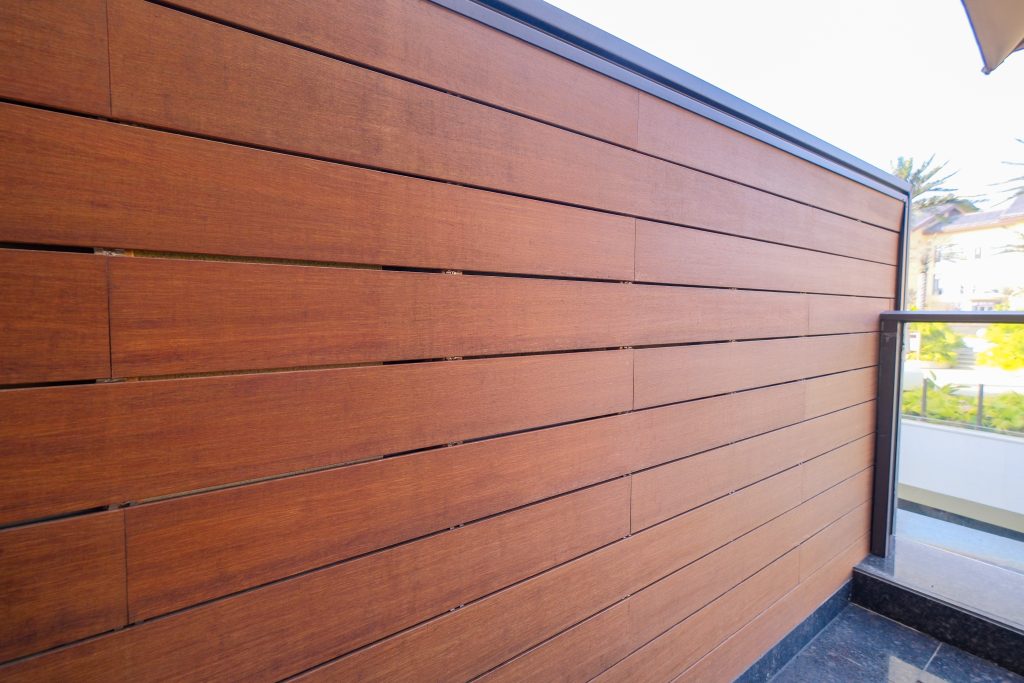
Wall finishes carry more square metres than any other interior surface, so the material choice shapes both the budget and the character of a building. Bamboo wall panels have moved well beyond sample boards: they now clad feature walls, corridors and entire building envelopes, combining a warm timber look with the dimensional stability of an engineered material.
Interior feature walls and corridors
Inside a building, the appeal is visual continuity. Bamboo plywood panels and fluted boards can be matched across a reception wall, lift lobby and corridor, then carried into joinery for a single material language. Grooved and V-grooved panels add shadow lines that hide minor substrate imperfections, while slatted panels let a wall read as texture rather than a flat plane. Because the panels are lightweight, they can go over existing substrates in refurbishment without heavy structural work.
Exterior cladding and the building envelope
Outdoors, the job changes. Bamboo facade cladding must shed rain, tolerate UV and resist mould. Carbonized, high-density strand-woven boards are the usual choice: the heat treatment reduces the sugars that feed surface fungi, and the dense structure limits water uptake. Boards are fixed as a ventilated rain-screen – an open cavity and a drainage path behind the cladding are not optional, they are what let the wall dry after rain.
Panel types at a glance
- Bamboo plywood panels – large, smooth sheets for clean, contemporary walls and joinery.
- Fluted / grooved panels – profiled boards that add rhythm and acoustic diffusion to corridors and feature walls.
- Slat screen panels – open battens for screens, balustrades and shaded facades.
- Strand-woven cladding boards – the dense, carbonized option for exposed exterior walls.
Detailing for moisture, fire and movement
Three details decide whether a bamboo wall lasts: a ventilated cavity on exterior work, sealed edges and fixings, and a documented fire classification for the finished system. Exposed boards need end sealing and corrosion-resistant clips; expansion gaps must be sized for the board’s movement range. Our cladding ventilation guide explains the cavity design, and sustainable bamboo facade cladding covers the exterior specification.
Specifying for a project
Ask suppliers for the panel’s moisture content at packing, a density or strength test report from the actual batch, the coating system, and the fire test certificate for the assembly. Confirm who supplies the sub-frame and clips – mixed systems are the most common source of callbacks. For sustainability paperwork, FSC chain-of-custody starts with traceable raw material, as explained in FSC bamboo for LEED and BREEAM projects.
Browse our bamboo wall panel collection to compare grooved, fluted and plywood options for interior and exterior projects.
Frequently asked questions
Can bamboo wall panels be used outdoors?
Yes, when they are carbonized, high-density boards installed as a ventilated rain-screen with sealed edges and corrosion-resistant fixings. Interior plywood panels should stay indoors.
Do bamboo walls need fire treatment?
Depending on the market and application, a reaction-to-fire classification is required. Ask for the certificate for the exact panel-and-coating system rather than assuming the raw material qualifies.
Are bamboo wall panels sustainable?
Bamboo regenerates in four to six years versus decades for hardwood, and engineered panels use the whole culm. Look for FSC chain-of-custody documentation to substantiate the claim.