The real test of a deck is not how it looks on installation day – it is how it behaves after five winters, a humid summer and a season beside a swimming pool. This is where outdoor bamboo decking earns its place: it is engineered to stay stable in the exact conditions that make traditional wood decking expensive to maintain.
One material, many outdoor environments
Specifiers choose strand woven bamboo because it adapts to a wide range of settings:
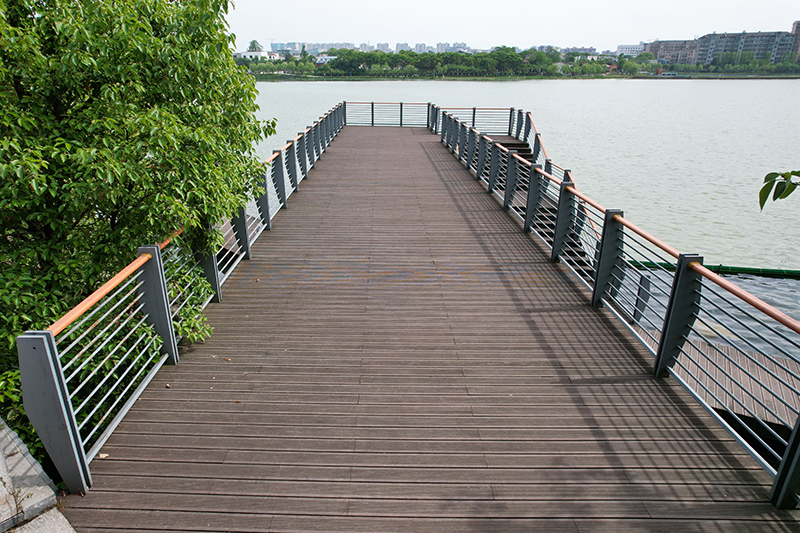
- Coastal and lakeside – high density and sealed surfaces resist salt spray and standing water; the boardwalk in our cover image is typical.
- Pool surrounds – carbonized boards resist chlorine splash and stay cool underfoot compared with dark stone or composite.
- Humid tropical gardens – reduced starch content after carbonization discourages mould and insect attack.
- Cold northern winters – low moisture uptake means less freeze-thaw stress, so boards are less prone to splitting.
- Rooftops and balconies – consistent lengths and light weight simplify installation over waterproof membranes.
Where wood decking struggles
Traditional timber – whether softwood, tropical hardwood or a composite board – has predictable weak points outdoors. Softwood cups, twists and needs regular staining. Tropical hardwoods resist decay but are heavy, expensive and increasingly regulated. Wood-plastic composites avoid rot but can sag over long spans, fade and feel hot underfoot. Bamboo addresses each of these without the same trade-offs: the pressed fibre structure resists splitting, the carbonized surface limits water absorption, and the board stays flatter over its service life.
The comparison that matters to buyers
On hardness and indentation, quality strand woven bamboo matches or exceeds many hardwoods. On dimensional stability under moisture change, it outperforms solid wood. On maintenance, it needs cleaning rather than sanding and sealing. On sustainability, bamboo regenerates in years while hardwood takes decades. A fuller head-to-head is in bamboo vs teak vs WPC decking, with fixing and spacing detail in joist spacing and fixing.
Installation detail still decides performance
Even the best board fails if it is installed without drainage. Use a ventilated substructure, seal all cut ends, keep the correct expansion gaps and choose corrosion-resistant fixings near water. The engineering behind the board’s crack resistance is explained in why outdoor carbonized bamboo decking resists cracking, and the product range is shown in our carbonized outdoor bamboo decking collection.
Frequently asked questions
Does bamboo decking work in cold climates?
Yes. Its low moisture uptake reduces freeze-thaw stress, so it splits far less than solid wood. Correct end sealing and expansion gaps are still essential.
Is bamboo decking better than wood decking?
For outdoor use it is usually more stable, more resistant to indentation and decay, and needs less maintenance – while growing back in a fraction of the time of hardwood.
Can bamboo decking be used poolside?
Yes. Carbonized boards tolerate chlorine splash and humidity well; specify slip-rated profiles and keep the substructure ventilated.