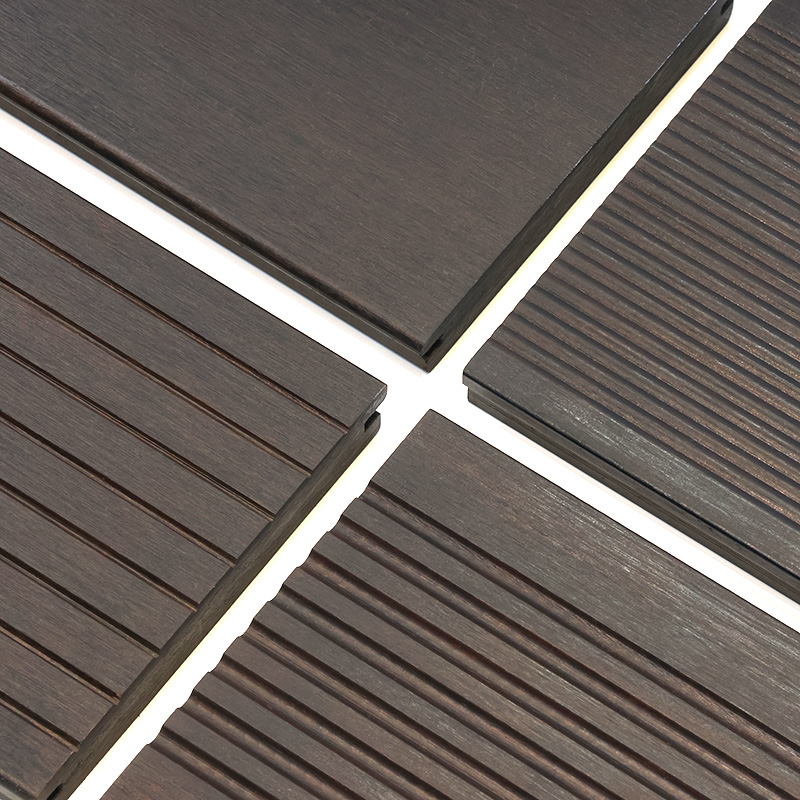
Cracking is the failure mode that ends most outdoor decks. Boards split along the grain, edges chip, and once water enters a crack the surface degrades fast. Outdoor carbonized bamboo decking is engineered specifically against this failure mode – and the reasons are worth understanding before you compare quotations.
Where cracks start
Almost every crack in outdoor flooring traces back to the same cycle: boards absorb rain in wet weather, dry out in sun and wind, and swell and shrink hundreds of times a season. Weak spots – knot voids, loose grain, poorly bonded glue lines – open first, and the crack propagates every time the board moves. Softwood decking and light hardwoods are the usual victims; wood-plastic composites avoid splits but pay for it in surface wear and sagging over spans.
Dense strand-woven grain leaves fewer weak paths
Carbonized strand-woven (heavy) bamboo starts as crushed bamboo fibre strands pressed under high pressure into a near-void-free block. Instead of one continuous grain line that can split end to end, the board is a mat of interlocked short fibres. Typical density reaches 1,100-1,200 kg/m3 – well above most outdoor hardwoods – which translates into a tighter, more splinter-resistant surface that resists both indentation and crack initiation.
Heat treatment removes the water pathways
Carbonization is not just a colour step. Sustained steam heat breaks down the hemicellulose and sugars inside the culm – the compounds that bind water and feed surface mould. Treated strands absorb less water, swell less, and move less between wet and dry seasons. Less movement means less stress concentrated on any single point of the board, which is precisely where cracking begins.
Moisture content is controlled before pressing
Strands are kiln-dried to a controlled moisture content before resin coating and pressing. Boards that leave the line out of specification will find their own equilibrium the hard way – on someone’s patio. Consistent incoming moisture content, combined with balanced profiles, keeps in-service movement small enough that surface cracks never get a start.
Board profiles that stop cracks from spreading
- Reeded (grooved) faces channel surface water away instead of letting it pool and soak in.
- Stress-relief grooves on the underside balance the section so boards stay flat rather than cupping.
- Hidden-clip fixing where the system allows it avoids through-screws that become future split points.
Pre-drilling end cuts and leaving correct expansion gaps at board ends remain basic installation discipline; our joist spacing and fixing guide covers the spacing rules in detail.
What this looks like after seasons outdoors
The practical difference shows up in the second and third year, not the first. Poorly made boards show the cycle early: face checks along the grain, lifting splinters at board ends, cupping where fixings pull tight. A properly pressed and treated carbonized strand-woven board weathers instead – the surface tone silvering gradually and evenly, while the section stays flat and the edges stay crisp. That is what a density report and a treatment record are actually buying you.
What to check before you buy
- Ask for a density test report from the actual production batch, not a catalogue sheet.
- Confirm the moisture content specification at packing.
- Check that boards have a balanced, grooved-back profile.
- Ask for project references two years or older in a comparable climate – the boards either stay intact or they do not.
For the wider specification picture – dimensions, coatings and installation – see our outdoor bamboo decking overview. And if you are weighing bamboo against hardwood or composite alternatives, the bamboo vs teak vs WPC comparison sets out the trade-offs.
Frequently asked questions
Does carbonized bamboo decking crack like hardwood?
Properly pressed strand-woven boards crack far less, because interlocked short fibres block split propagation and the heat-treated material takes up less water. Installation discipline still matters: end sealing and correct gaps are part of the system.
How long does outdoor carbonized bamboo flooring last?
Well-installed boards in comparable climates commonly serve well beyond a decade, and suppliers should prove it with references from projects two years or older rather than with lifespan claims on a datasheet.