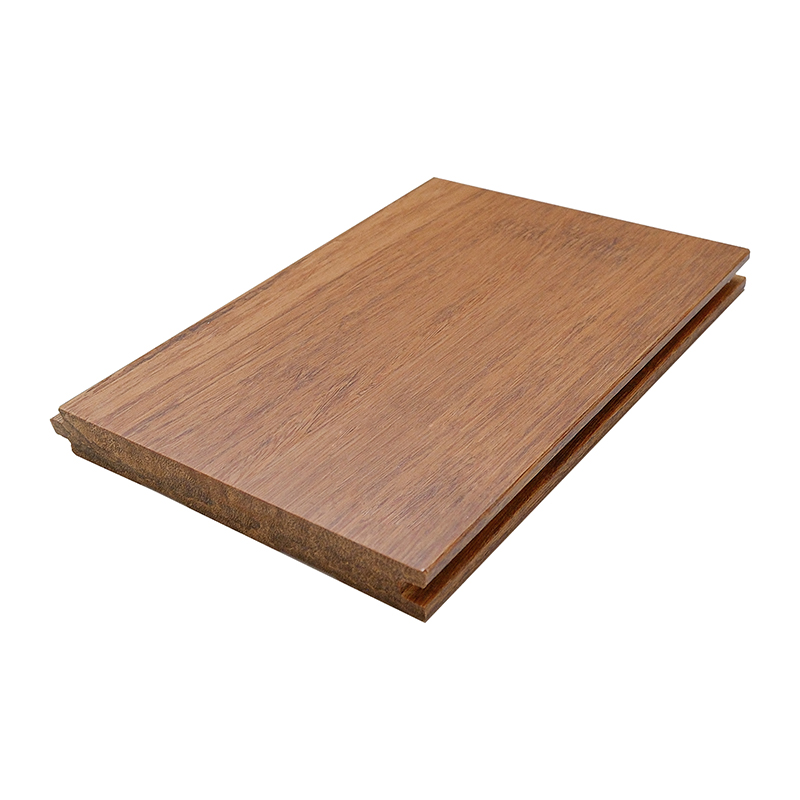
Carbonization is often described as a colour choice: caramel for carbonized, pale for natural. That undersells what the treatment actually does. Heat treatment is a chemistry step, and for outdoor bamboo flooring it is the difference between a board that survives seasons outdoors and one that only looks good on arrival.
What happens inside the treatment chamber
Strands are steamed at elevated temperature under controlled pressure. Three things happen, in escalating order of treatment time and temperature: residual sugars and starch break down; hemicellulose – the component that binds water most readily – degrades; and the natural resins darken the material from pale blond through caramel to deep espresso. Indicative cycles run at elevated steam temperatures for one to several hours; exact parameters vary by line, strand thickness and target colour, so treat any single published number as a starting point rather than a specification.
Longer treatment, deeper change
Extended heat treatment pushes all three reactions further:
- Less food for decay. Sugar and starch are what mould and surface fungi feed on. Longer cycles strip more of them out – valuable outdoors, where boards can stay wet for days at a time.
- Less water uptake. With less hemicellulose to bind water, treated strands absorb less, swell less and move less. Movement is what drives cracking, cupping and end-splitting.
- Deeper, more even colour. Extended treatment darkens the full section, not just the surface – so profile cuts and arrises keep the same tone instead of showing pale edges.
This is why the carbonized boards in our outdoor decking range hold a single, consistent colour even after machining.
The trade-off: stability against brittleness
Heat treatment is not free. Every additional hour in the chamber removes some of the material’s natural flexibility, and an over-treated board gains a little more stability but loses bending strength and becomes brittle under impact. The production skill is in the window: treat long enough to lock in water and decay resistance, and stop before strength pays for it. What matters when comparing suppliers is batch testing on the actual line, not a brochure figure.
Colour consistency across batches
Because colour is a by-product of the treatment, consistent colour is evidence of a controlled process. We hold treatment parameters fixed per batch and check finished colour against retained samples. Buyers comparing suppliers should ask exactly that question: how do you keep batch five the same colour as batch one?
Carbonized or natural for outdoor use?
Both start from the same strand-woven base; the difference is treatment depth. For full outdoor exposure we recommend carbonized: the extra water and decay resistance outweighs the small strength trade-off. For covered or interior applications the natural finish keeps more raw strength – the full comparison is in carbonized vs natural bamboo. And for the failure mode this treatment prevents, see why outdoor carbonized bamboo decking resists cracking.
Frequently asked questions
Does longer carbonization make bamboo weaker?
Beyond the optimal window, yes – over-treated boards turn brittle. A controlled treatment window keeps the strength loss small while gaining the water and decay resistance that outdoor flooring needs.
Why does my carbonized decking look darker than the sample?
Colour drifts when treatment parameters are not held fixed. Ask suppliers how they control batch colour against retained samples; consistent colour is a proxy for a controlled process.